
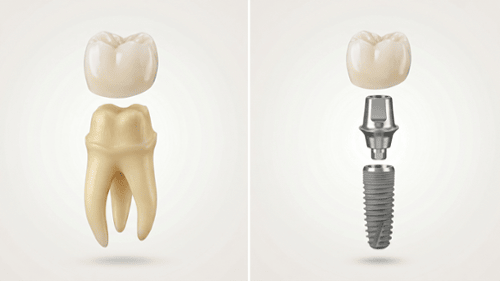
Patients often ask whether a dental crown or a dental implant is better.
It is a common question, but dental implants and crowns are different tools for different jobs. The question really being asked is:
Should this tooth be saved with a crown, or is it best to replace it with an implant?
We will explain that in detail, after some background so we're all on the same page:
A dental crown is used when we are trying to keep your natural tooth. It covers the tooth like a protective helmet or cap, while your own root stays in the jaw.
A dental implant is different. It is used when the tooth is missing, or when the tooth is too damaged, cracked, or infected to rely on long-term. In that case, the tooth is removed and replaced with an implant, which acts like an artificial root. A crown is then attached on top.
So the answer is not simply that one is better than the other. It depends on the tooth we are starting with.
The better question: can the tooth be saved?
In dentistry, we generally prefer to keep natural teeth where it makes sense.
As a rule of thumb, if the gums and nerve of the tooth are happy, then a crown of some kind is very likely to be able to fix the tooth back up, because there is a good foundation to work on.
If the nerve is not happy, for example, if it is infected or dead, then a root canal procedure is usually needed to fix that first. After that, a crown can often be used to strengthen the top of the tooth back up.
If this is not possible, then the tooth almost always needs to be removed to prevent ongoing pain and sometimes serious, even life-threatening, infections from occurring.
The gums are just as important.
If the gums are significantly unhappy, for example, with severe gum disease, or if there are added risk factors like diabetes, immune disorders, or smoking, then the tooth sometimes needs to come out as well.
An important fact to consider is that implants should not be placed in mouths with active gum disease; otherwise, the gum disease can spread to the implant too.
So if the tooth needs to be removed because the foundation is poor, and the gums are in pretty healthy condition, meaning no active periodontitis, then an implant may be a great and cost-effective long-term solution. It is usually a higher cost upfront, but can be cheaper in the long run.
This is a simplified way of explaining how your dentist is looking at things when we are giving an examination. There is a lot of nuance, and the devil is really in the details when it comes to dentistry and biology. That is why it is best to have a proper professional assessment before deciding whether a crown or implant is the better option.
What a dental crown does
A dental crown is a custom-made cover that fits over your existing tooth.
It is commonly used for teeth with:
- Large fillings
- Cracks
- Broken cusps
- Root canal treatment
- Heavy wear
- Not enough tooth left for a normal filling
A crown does not replace the root. It protects the tooth you already have.
If the root is healthy, the gums and bone support are good, and there is enough tooth left to hold the crown, saving the tooth is often the most conservative choice.
When a crown may not be enough
Sometimes patients ask, “Can’t we just put a cap on it?”
Sometimes, yes.
But not always.
A crown may not be the right option if:
- The tooth is split
- The crack runs below the gum
- The root is fractured
- The nerve is infected and the tooth cannot be properly root canal treated
- There is severe gum disease or major bone loss
- There is not enough tooth left to hold a crown properly
- The tooth has already been patched many times
From the outside, it may still look like there is a tooth there. But the important part is the foundation underneath. That means the root, the nerve, the gums, the bone support, the crack pattern, and how much healthy tooth is left.
What a dental implant does
A dental implant replaces a missing tooth.
The implant itself is placed into the jawbone and acts like an artificial tooth root. Once it has healed, a crown is attached to the top.
This is where the wording can be confusing.
A natural tooth can have a crown.
An implant can also have a crown.
The difference is what is underneath.
With a normal dental crown, your natural root is still there.
With an implant crown, the original tooth has been removed and the implant supports the new tooth.
When an implant may be better
An implant may be the better option when the existing tooth cannot be saved predictably, and the gums and bone are healthy enough for implant treatment.
This may be due to a deep crack, vertical root fracture, severe decay, repeated infection, poor bone support, or not enough tooth structure left.
Implants can also be a good option when a tooth is already missing and you want a fixed replacement.
One advantage of an implant is that it stands on its own. It usually does not require the neighboring teeth to be hold the replacement tooth like a bridge, which can be helpful if those teeth are healthy.
But implants need healthy foundations too. If there is active gum disease, that needs to be treated first. Otherwise, the same disease process that damages teeth can also damage the gum and bone around implants.
Which lasts longer?
A crown on a good tooth can last a long time.
An implant can last even longer if it's kept clean and healthy.
The key is choosing the right treatment for the right situation.
Problems happen when we try to crown a tooth that is already too compromised, or when we remove a tooth that could have been predictably saved.
The goal is not to choose the most aggressive option. The goal is to choose the option that gives the best long-term outcome for you and your teeth. A cheap quick solution may become the most expensive one, given a bit of time.
Cost, time, and maintenance
Crowns are usually faster and less expensive upfront. They are often completed over a couple of appointments.
Implants usually take longer and cost more upfront because there are more stages involved. The tooth may need to be removed, the area may need to heal, and the implant needs time to integrate with the bone before the final crown is placed.
But cost depends on the situation.
If the tooth is restorable, a crown may be the best value.
If the tooth has a poor long-term outlook, an implant can sometimes be the more cost-effective option over time because it avoids repeatedly spending money trying to rescue a tooth that is unlikely to last.
Both options still need maintenance.
A crowned tooth can still get decay around the edges. An implant cannot get decay, but the gum and bone around it still need to stay healthy.
What if you leave the gap?
If a tooth is removed and not replaced, the nearby teeth can drift, the opposing tooth can over-erupt, food can pack into the space, and the bite can change.
The bone in the area will greatly shrink over time, which may make future implant treatment more complex, requiring bone grafting to correct.
Doing nothing is still a decision, but it's worth understanding the risks.
So which is better?
In a very simplified sentence or two:
If your tooth has a healthy nerve and roots / gums as it's foundation, a crown is often the better option because it keeps your natural tooth.
If the tooth is too damaged, cracked, infected, or unstable to rely on, an implant may be the better long-term solution.
Speak to your dentist is the best answer, but hopefully you can come more prepared to your appointment, and understand a bit more of what the options are.
At Providence Dental Care in West Lakes, we can assess the tooth, explain whether it has a good long-term outlook, and talk through the pros and cons of saving it with a crown versus replacing it with an implant. If you want more information and clarity, book a new patient assessment for detailed answers, or a consultation for just a chat with our friendly team.