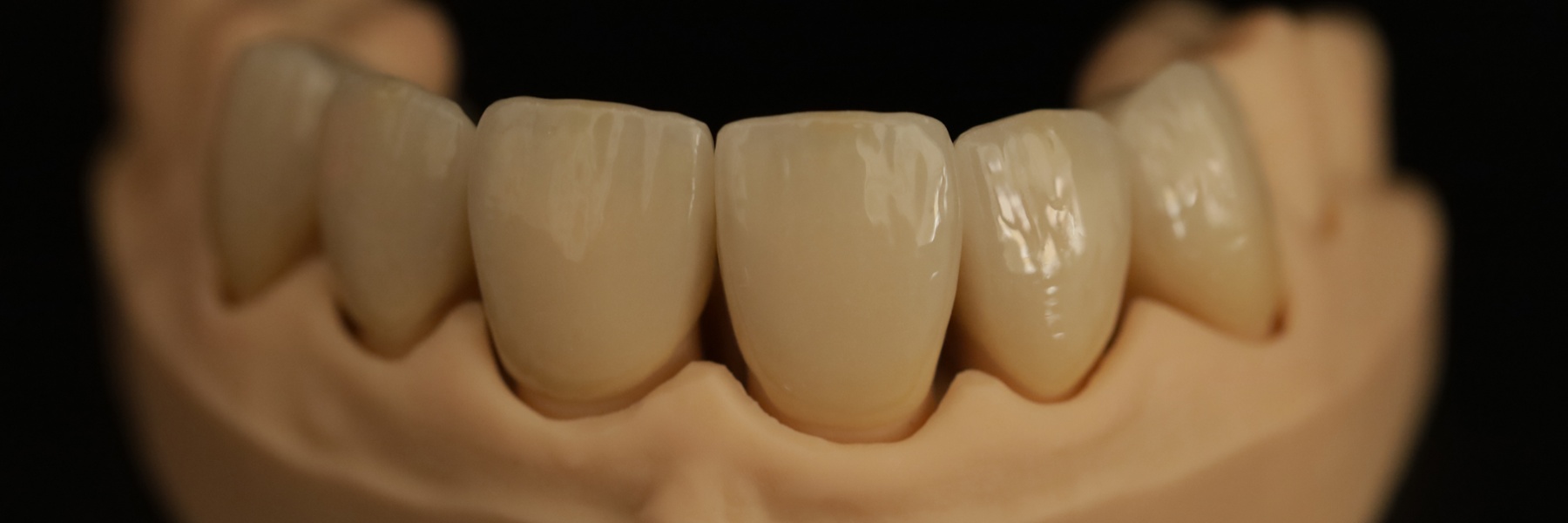

Crowns are perhaps one of my favourite tools to help restore damaged teeth back to their former glory. Across my career I've done many hundreds of them made out of all sorts of different materials, and have seen how well they work to reliably repair decaying, broken down and cracked teeth. Nothing lets us reconstruct and prevent the loss of teeth like crowns do (when indicated).
Often, fixing a problem the right way means moving past a simple filling and looking at a more permanent solution like a crown. I know a "crown" can sound intimidating, but I'll show you below what they are, how they're done, and why it's a reliable and long lasting treatment for the teeth than need them.
What exactly is a dental crown?
Think of a crown as a custom-engineered "helmet" for your tooth. While a filling sticks in and on the tooth, a crown provides coverage to protect the remaining structure.
Sometimes they encase the entire tooth down to the gum line, but the don't have to. Depending on how much healthy tooth you have left, we can often provide "partial coverage." This is actually my preferred approach when possible because it allows us to be conservative and keep more of your natural tooth structure intact. Whether full or partial, a crown allows us to accurately recreate the tooth's shape and provides the longest-lasting restorative option we have.
When do we recommend a crown?
I’ll always be honest with you: if a small filling will do the trick, that’s what we’ll do. But there are specific times when a crown is the only predictable way forward:
-
The "Glass Window" Analogy: Your tooth enamel is incredibly strong, but it behaves a lot like a glass structure. It can handle a lot of force, but if it gets a tiny chip or a crack, that crack can spread through the rest of the tooth just like a crack in a windowpane. If that crack spreads into the nerve, you’re in significant pain and will likely need a root canal to save the tooth. If it spreads further down the root, the tooth usually can’t be saved at all.
-
When big fillings start to fail: Old fillings don't just "wear out"; they can actually start lifting up or "debonding" from the tooth. This allows decay to start growing underneath the old filling where you can't see it.
-
The Amalgam Issue: Silver amalgam fillings are notorious for this. They are incredibly strong, which is why they can stay in your mouth for decades, but they don't bond to the tooth. Over years of chewing, they can act like a wedge, putting constant pressure on the tooth and creating deep cracks that eventually cause the tooth to split.
-
After root canal treatment: A root canal effectively hollows out the inside of a tooth, making it much more brittle. The long-term success of that root canal is almost always directly tied to whether or not a crown was placed afterward to hold the tooth together and prevent it from snapping.
-
Restoring your bite: If your teeth are heavily worn from acid erosion or grinding, we can use crowns to functionally restore your bite and choose materials that help prevent that wear from continuing.
So, what are they made of?
We select materials based on what is right for your specific mouth and where the tooth is located. While there are many options, these are the main ones we use:
-
Glass Ceramics: We use these for both front and back (posterior) teeth. They offer the best translucency and look the most like a natural tooth. While they are multiple times stronger than standard filling materials, they aren't quite as indestructible as some other options.
-
Zirconia Ceramics: This isn't just a "heavy-duty" option; modern high-strength zirconia is also used in aesthetic cases because it’s incredibly versatile. It has roughly 10 times the compressive strength of standard filling materials, making it a great choice if you have a very "heavy" bite.
-
Gold: In many ways, gold is still the "gold standard." It’s incredibly biocompatible and it has a unique "willingness" to bend and wear slightly over time rather than breaking. However, with the rising price of gold, fewer patients choose it, and fewer labs are willing to make them anymore.
-
Porcelain Fused to Metal (PFM): We use these much less commonly now. The problem is that the porcelain layer is prone to chipping off over time. When that happens, it leaves the abrasive grey metal underneath exposed, which can be quite unsightly and rough on your other teeth.
The process: What to expect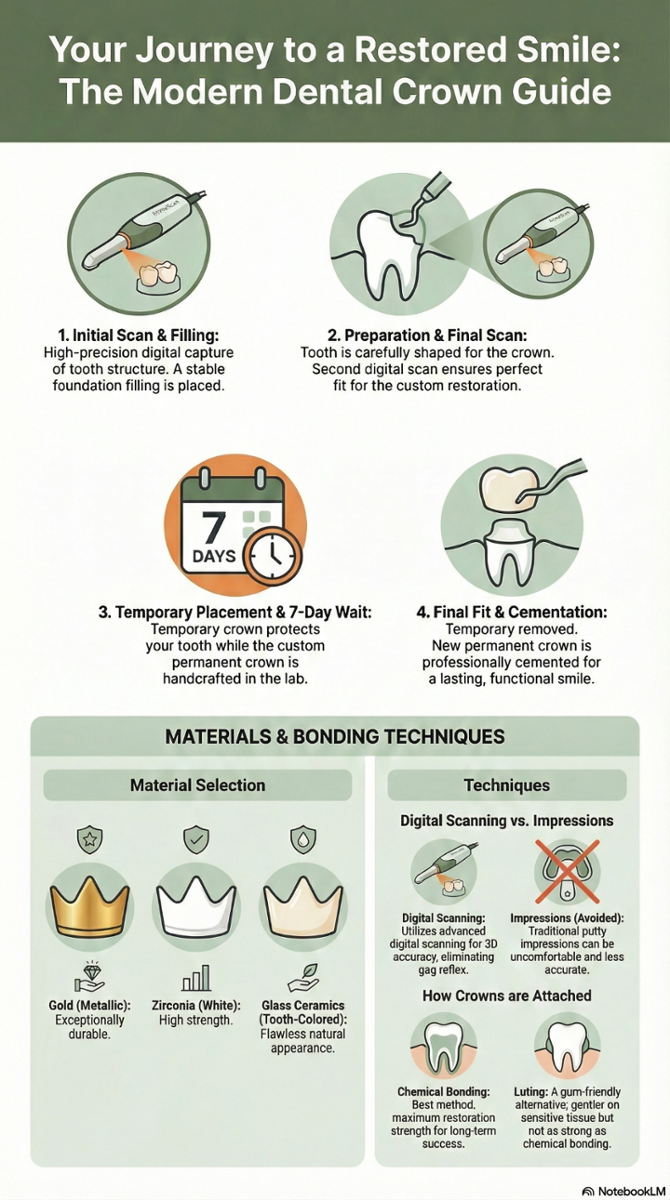
We take the time to do each step meticulously so the result is predictable.
-
The Foundation: We remove any decay or unhealthy old filling material and replace it with a fresh filling to create a clean, strong foundation.
-
The Preparation: We shape the tooth, removing as little structure as possible to preserve your natural tooth.
-
The Scan: We use our Intraoral digital scanner (Primescan) to take a high-definition 3D digital model of the tooth.
-
The Interim: You’ll wear a temporary crown for about a week while your final crown is fabricated in a specialized lab using 3D milling after custom designing, then furnacing the ceramic up to 1600 degrees.
-
The Fit: We remove the temporary and clean the tooth. To fix the crown in place, we use one of two methods:
-
Chemical Bonding: This is a very technique-sensitive process that uses an extremely strong bonding agent. It is my preferred method for conservative or partial crowns because it essentially "fuses" the ceramic to the tooth.
-
Traditional Cement: This is a more "gum-friendly" option. We use this when a crown needs to sit deeper toward the gum line. It ensures the surrounding tissue isn't irritated by the stronger chemical agents being stuck where they shouldn't be.
-
Crowns on the front teeth
Crowns at the front of the mouth need to be strong, functional and also aesthetic. For these crowns we often recommend visiting the lab that is making them for a shade match. In the shade matching visit the technicians map out the exact colours of your existing teeth, and allow them to paint like artwork, every little characteristic in to your new crown.This means that they match beautifully and look natural.
We don't charge anything to patients for this added step, and we highly recommend it for any ceramic work on front teeth. The labs we use are local SA businesses, so it's very easy and not far from our practice in West Lakes to visit them - and we help coordinate it too.
Is a crown right for you?
The best way to know is to ask us during a consultation here at Providence Dental Care. We will give you honest advice on whether a crown is the best move for your specific situation, or if it isn’t.
If your teeth are heavily decayed, filled with old amalgams, or you’re starting to see those "glass-like" cracks appearing, feel free to reach out. We provide clear, written treatment plans so you know exactly what to expect before we ever start.
P.S Have a look at our before and after gallery to see some examples of the visual changes crowns on front teeth can have.